
Thirteen
1 ) Lemon Poem Song
2 ) Open Road
3 ) Seven Hours
4 ) Waltz for Robert
5 ) The Longest Night
6 ) Disappear
7 ) Green Books
8 ) Beledo Balado
9 ) Pens to the Foal Mode
10 ) Time Station
11 ) Which Bridge Did You Cross
12 ) Turmoil
13 ) Daevid's Special Cuppa
Soft Machine – Thirteen
(Dyad Records through Proper)
John Etheridge – electric guitar
Theo Travis - tenor & soprano saxes, flute, Fender Rhodes piano, electronics
Fred Thelonious Baker – bass guitar
Asaf Sirkis - drums & percussion
‘Thirteen’ is the thirteenth studio album by Soft Machine. Comprising thirteen brand new tracks, the album marks a new chapter in the group’s 60 year history. Whilst the line-up of Soft Machine may have changed many times since the heady days of the late 1960's, the band's spirit of musical adventure, and the ease with which it freely avoids being pigeonholed has stayed a constant – as it moves from powerful progressive jazz rock to atmospheric psychedelia to free improvised jazz to ambient loop music.
‘Thirteen’ features legendary guitarist John Etheridge who has been with the band over 50 years. All four members of the band contribute compositions, and the album was produced by band member Theo Travis. The newest member of the group is drummer and composer Asaf Sirkis. Former Soft Machine drummer and songwriter Robert Wyatt said of Asaf –
“I’ve known Asaf’s gifts for years, certainly enough to say that as far as I can see there’s nothing he can’t do when he puts his mind to it…..his kit skills just keep expanding but what really gets to me are his ethereal, haunting compositions.…”
The album is incredibly broad in its breadth and scope. Tracks include ‘Pens to the Foal Mode’ which is a completely free group improvisation; ‘Open Road’ a rocky track which sees the band soaring on all burners with fiery solos by both Etheridge and Travis; the ballad ‘Disappear’ which starts with ethereal looped flutes and develops into a beautiful piano led and drum less miniature and ‘Turmoil’ penned by bassist Fred Baker which brims with deranged fuzz bass, manic solos and an almost unhinged clamor. ‘Daevid’s Special Cuppa’ sees a cameo by founder member Daevid Allen (his guitar part being recorded years earlier, and the track built around it) in a psychedelic tribal set piece with soprano sax, guitar and duduk (a haunting Armenian traditional wooden flute like instrument) floating over hypnotic rhythms.
A special 2LP vinyl edition is being released which will feature an exclusive whole side of bonus tracks.
The band will be touring the UK and Europe extensively in 2026.
See live dates here- https://softmachine.org/touring/on-tour
Produced by Theo Travis
Recorded by Ru Lemer at Temple Music Studio, Surrey April 2025
Mixed by Andrew Tulloch at the Blue Studio, London August/September 2025
Mastered by Andrew Tulloch at the Blue Studio, London November 2025
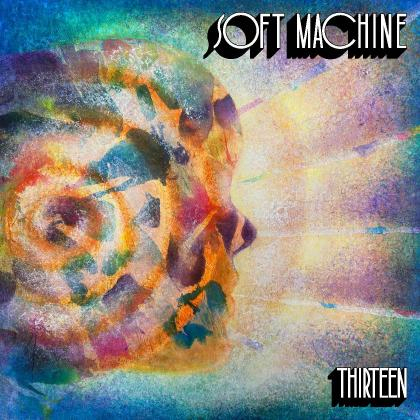
Cover artwork is by Turkish artist Esra Kizir Gokcen.
The band will launch the album and UK/ Europe with a special gig at Ronnie Scotts Club , London on 19 March 2026
Order the album here (CD/ LP)-
Download the Thirteen album launch press release here
It’s a strange and beautiful thing to witness a band with sixty years of history sounding not just alive, but newly awakened. Soft Machine - the psychedelic adventurers who once shared stages with Hendrix, the Canterbury visionaries who helped define jazz fusion before the term even existed - return with Thirteen, an album of thirteen new tracks that feels both deeply rooted and unexpectedly fresh.
What has always set Soft Machine apart is their willingness to inhabit contradiction: experimental yet melodic, precise yet spontaneous, cerebral yet playful. On Thirteen, those contrasts are magnified. The sound is broad and cinematic in places - widescreen, atmospheric, alive with colour - yet close, intimate and intensely personal in others. Music that can bloom with orchestral expansiveness, then fold into the quiet of four musicians breathing as one.
A special mention must go to Theo Travis, whose flute work across the record is one of its most quietly compelling features. Travis has always been a master of phrasing - lines shaped with the ease of spoken language - but here he reaches a new level. His flute becomes conversational, rising and falling like thought itself, warm with breath, rich with nuance. At times he floats long, luminous arcs over Etheridge’s guitar; at others he nudges the music with tiny, questioning gestures. It’s playing that gives the album much of its emotional intimacy.
And then there is John Etheridge - the quiet constant of the band’s modern era. On Thirteen, he sounds revitalised - loose, fiery, affectionate in tone, almost conversational in phrasing, yet always tethered to the band’s expansive, exploratory spirit. His contribution reaches its peak in The Longest Night, the album’s thirteen-minute epic. In the midst of its fluid, shifting landscape, Etheridge’s three-minute guitar solo emerges as a genuine high point - a passage that ebbs and flows with a storyteller’s instinct. It’s beautifully paced, emotionally transparent, and delivered with a poise that elevates the entire composition. This is Etheridge not merely performing within Soft Machine’s legacy but actively advancing it.
Fred Thelonious Baker anchors the group with muscular, inventive bass lines, while newcomer Asaf Sirkis energises the band with drumming that is fluid, responsive and full of colour. Robert Wyatt’s line that “there’s nothing he can’t do” feels completely deserved.
Highlights abound: the ferocious drive of Open Road, the elegant miniature Disappear, the hallucinogenic swirl of Daevid’s Special Cuppa, complete with Daevid Allen’s spectral cameo. Even the free-flowing Pens to the Foal Mode bristles with shape and purpose.
For a band who helped invent the language of fusion, it is heartening - almost miraculous - that Thirteen feels so vital, unforced and forward-looking. This isn’t legacy maintenance. It’s not nostalgia. It’s Soft Machine doing what they have always done at their best: redrawing their own map in real time.
A bold, moving and unexpectedly modern new chapter from one of British music’s great institutions.
Glenn Wright /Bebop Spoken Here (5 Feb 2026)
Album review: Soft Machine - Thirteen (Dyad Records)
Theo Travis (flute, saxes, Rhodes, electronics); John Etheridge (guitar); Fred Thelonious Baker (bass guitar); Asaf Sirkis (drums, percussion)
It’s a strange and beautiful thing to witness a band with sixty years of history sounding not just alive, but newly awakened. Soft Machine - the psychedelic adventurers who once shared stages with Hendrix, the Canterbury visionaries who helped define jazz fusion before the term even existed - return with Thirteen, an album of thirteen new tracks that feels both deeply rooted and unexpectedly fresh.
What has always set Soft Machine apart is their willingness to inhabit contradiction: experimental yet melodic, precise yet spontaneous, cerebral yet playful. On Thirteen, those contrasts are magnified. The sound is broad and cinematic in places - widescreen, atmospheric, alive with colour - yet close, intimate and intensely personal in others. Music that can bloom with orchestral expansiveness, then fold into the quiet of four musicians breathing as one.
A special mention must go to Theo Travis, whose flute work across the record is one of its most quietly compelling features. Travis has always been a master of phrasing - lines shaped with the ease of spoken language - but here he reaches a new level. His flute becomes conversational, rising and falling like thought itself, warm with breath, rich with nuance. At times he floats long, luminous arcs over Etheridge’s guitar; at others he nudges the music with tiny, questioning gestures. It’s playing that gives the album much of its emotional intimacy.
And then there is John Etheridge - the quiet constant of the band’s modern era. On Thirteen, he sounds revitalised - loose, fiery, affectionate in tone, almost conversational in phrasing, yet always tethered to the band’s expansive, exploratory spirit. His contribution reaches its peak in The Longest Night, the album’s thirteen-minute epic. In the midst of its fluid, shifting landscape, Etheridge’s three-minute guitar solo emerges as a genuine high point - a passage that ebbs and flows with a storyteller’s instinct. It’s beautifully paced, emotionally transparent, and delivered with a poise that elevates the entire composition. This is Etheridge not merely performing within Soft Machine’s legacy but actively advancing it.
Fred Thelonious Baker anchors the group with muscular, inventive bass lines, while newcomer Asaf Sirkis energises the band with drumming that is fluid, responsive and full of colour. Robert Wyatt’s line that “there’s nothing he can’t do” feels completely deserved.
Highlights abound: the ferocious drive of Open Road, the elegant miniature Disappear, the hallucinogenic swirl of Daevid’s Special Cuppa, complete with Daevid Allen’s spectral cameo. Even the free-flowing Pens to the Foal Mode bristles with shape and purpose.
For a band who helped invent the language of fusion, it is heartening - almost miraculous - that Thirteen feels so vital, unforced and forward-looking. This isn’t legacy maintenance. It’s not nostalgia. It’s Soft Machine doing what they have always done at their best: redrawing their own map in real time.
A bold, moving and unexpectedly modern new chapter from one of British music’s great institutions. Glenn Wright
Soft Machine — Thirteen Review from DPRP by Owen Davies
Could this be the best Soft Machine album ever released?
Well, quite possibly.
Thirteen delivers a wide mix of styles and offers an adventurous exploration of progressive musical forms. It will probably appeal to fans of many different incarnations of Soft Machine.
Blustery jazz fusion pieces rise, roll, and pitch. They stand shoulder to shoulder with challenging free jazz that intrigues, and stimulates. Ambiently looped interludes drone, drift, lather, and linger.
Beautifully crafted tunes highlight elegant melodies that lighten the mood and soothe aching limbs. Swinging instrumental crescendos peak, dart, and dash. Guitar growling, sax howling, bass rumbling, drum rolling and organ-bellowing interludes ignite proceedings in an exhilarating fashion.
Thirteen is the band's 13th studio album. It features 13 tracks, and its longest piece clocks in at over 13 minutes.
Ever since their inception in 1966, Soft Machine have pursued an audacious quest to innovate and explore genre boundaries. Consequently, their music has incorporated many styles and consistently challenged accepted musical norms. Thirteen continues that tradition and does so with admirable conviction.
The psychedelic pop leanings of the first two albums are not represented though. Nevertheless, the band's early heritage is not entirely overlooked, as the concluding track features founder Daevid Allen playing glissando guitar. It is Allen's first appearance on a Soft Machine recording since 1967. His contribution originates from a studio session with Theo Travis when both were members of Gong.
The album's bold creative flair is driven and made possible by its different composers. There is no doubt that one of the major strengths of the album lies in the varied approach that each composer bring to the table. This ensures that Thirteen has an exciting edge. It is never locked into a predictable sound, a consistent tempo, or a particular ambience. Consequently, Thirteen is an engaging and immersive experience from start to finish.
Theo Travis composed six of the tunes. Asaf Sirkis penned three tracks. John Etheridge contributed two pieces. Fred Baker composed Turmoil. The improvised Pens To The Foal Mode is credited to the full ensemble.
The album begins in forthright fashion with Lemon Poem Song. It is an airy composition that is rich in space and atmosphere. Its expansive qualities, and particularly Sirkis' supportive kit work, create a broad sonic environment. The piano melody is colourfully textured and embroidered by Etheridge's fluid guitar. His fluttering solo is lyrical and emotive, stretching upward before skilfully reinforcing the piece's slightly dissonant, dominant piano theme.
The overall atmosphere of the tune was reminiscent of the characteristics shown in Sirkis' superb solo album The Journey is You.
Etheridge's playing throughout this latest Soft Machine release is magnificent, and it is arguably his most accomplished recorded performance in years.
Time after time his exploration of the fret board evokes feelings of awe and wonder. His work on Open Road, The Longest Night, Green Books and Balado Beledo projects a fresh, youthful exuberance that belies his age.
The extended solo in The Longest Night is especially compelling. It emerges languidly, it soars and thermals towards the higher registers with accomplished ease. Repeated phrases bark, splutter, screech, and spin. Garlanded by a majestic resonance; head-spun, gurn-faced, it fades into the distance. The subtle tonal qualities linger, offering the listener a moment of reflection to appreciate Etheridge's brilliance and to absorb the whole experience.
The other parts of the tune are equally impressive. Travis' nimble flute work and piercing tone balances aggression with finesse. Guest organist Pete Whittaker's rich-pipe-pushed tone, cleverly bridges sections of the piece to enhance the tune's dynamic impact. The ensemble interplay throughout is quite special.
The rumbustious galloping jazz fusion of tunes such as Open Road and Green Books is exciting, but the slower relaxing canter of pieces like Waltz for Robert and Balado Beledo are especially appealing. Both tunes prioritise elegance and tunefulness over raucous intensity, or Avant dissonance.
Waltz for Robert works beautifully on many different levels. It is another composition by Sirkis and once again, it is characterised by a sense of restful airiness. Gentle drums caress the melody and Travis' fluted tones delicately caress the senses. His gorgeous playing lifts the mood of the piece and evokes a range of emotions. Travis' mastery of the silver tube compares favourably with the control and fluidity exhibited by such renowned flautists such as, Herbie Mann, or Hubert Laws.
Balado Beledo is a dedication by Etheridge to Uruguayan guitarist Beledo and is a heartfelt tribute.
Beledo rescued the Softs' tour of the USA in 2023 when he stepped in at short notice to fulfil the band's bass duties. It is a stunning piece. Etheridge's wail, hail and praise solo and expressive tones are absolutely gorgeous. Baker's concluding bass flurry adds some refined low-end textures. His spotlight slot complements the overall flavour of the piece and is a fitting expression of the band's gratitude.
It is perhaps too early in 2026 to suggest that Thirteen may rank in my top ten releases of the year.
However, it may well be a contender.
It is accomplished, it is adventurous, it is varied; it is simply very good.
Indeed, Thirteen may already even be the Softs' best release!